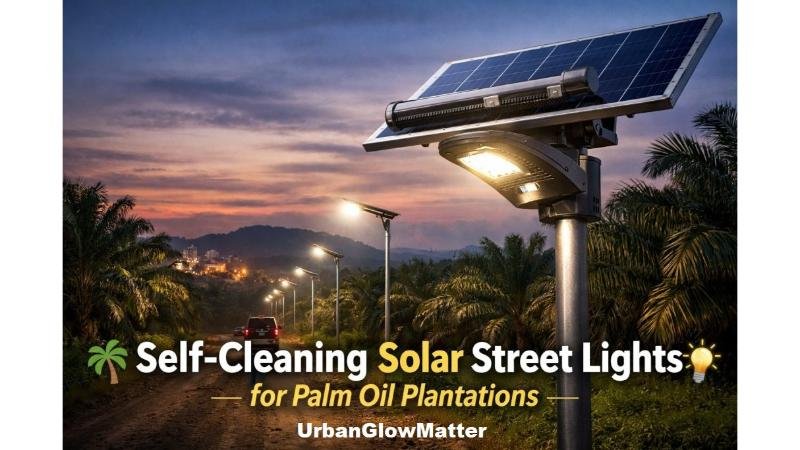
Oil palm plantations generate massive volumes of agricultural waste while facing persistent challenges with public and plantation lighting. Dust, oil mist, pollen, and high humidity cause conventional solar streetlights to lose 30–40% efficiency within months, driving up maintenance costs and reducing reliability. Self-cleaning streetlights that incorporate oil palm waste address both issues simultaneously. They valorize residues such as empty fruit bunches (EFB), palm kernel shells (PKS), mesocarp fibers, and palm oil fuel ash (POFA) into bioenergy for hybrid power systems and functional materials for durable, hydrophobic or photocatalytic coatings.
This creates a true circular-economy solution: waste from the palm industry powers and protects the very infrastructure that lights its roads and communities. As a content architect focused on sustainable infrastructure, I have analyzed real-world deployments (such as BOSUN’s self-cleaning systems in Nigerian palm belts) and peer-reviewed research on POFA-derived silica coatings. This guide delivers the most comprehensive, actionable overview available, covering science, engineering, benefits, implementation, and future potential.
Why Oil Palm Waste Is Ideal for Self-Cleaning Streetlights
Global palm oil production generates roughly 4–5 tons of biomass waste per ton of oil produced. Key residues include:
- Empty Fruit Bunches (EFB): Fibrous, ~12–15 MJ/kg calorific value, excellent for biochar or pellets.
- Palm Kernel Shells (PKS): Hard, high-energy (~18–20 MJ/kg), ideal for biomass fuel or activated carbon.
- Mesocarp Fibers: ~15–17 MJ/kg, suitable for hybrid energy systems.
- Palm Oil Mill Effluent (POME): High methane potential via anaerobic digestion.
- Palm Oil Fuel Ash (POFA): Rich in silica (up to 50–60%), perfect for nanoparticle extraction in coatings.
These wastes are often burned openly or landfilled, releasing greenhouse gases. Repurposing them reduces emissions while supplying renewable energy and raw materials for self-cleaning surfaces.
How Self-Cleaning Technology Works in These Streetlights
Self-cleaning relies on two primary mechanisms, often combined with oil palm-derived enhancements:
- Hydrophobic (Water-Repellent) Coatings Silica nanoparticles extracted from POFA or palm ash create superhydrophobic surfaces (contact angle >150°). Water beads up and rolls off, carrying dust, oil mist, and grime. Research shows POFA-based coatings achieve excellent self-cleaning without fluorine compounds, making them eco-friendly and cost-effective.
- Photocatalytic Coatings TiO₂ combined with palm-derived biochar or activated carbon breaks down organic pollutants under sunlight. Rain then washes away the decomposed residue. These coatings also offer antimicrobial properties.
Additional mechanical options (used in commercial systems like BOSUN’s African deployments):
- Automated robotic wiper arms or brushes that activate for 30–60 seconds daily (consuming <2% energy).
- Vibration or sensor-triggered systems for dusty/oily environments.
In palm plantations, nano-hydrophobic layers plus robotic dry cleaning maintain ~95% solar efficiency even with heavy oil mist and 80%+ humidity.
Hybrid Energy Systems: Solar + Oil Palm Biomass
Pure solar systems falter during prolonged cloudy periods common in tropical palm regions. Hybrid designs integrate:
- Primary monocrystalline solar panels with self-cleaning coatings.
- Backup biomass/biogas generators using processed PKS pellets, EFB biochar, or POME-derived methane.
- Intelligent MPPT controllers and LiFePO₄ batteries (3–5 days autonomy).
This ensures uninterrupted lighting on plantation roads, rural highways, and smart-city corridors while diverting waste from landfills or open burning.
Key Benefits of Self-Cleaning Streetlights Using Oil Palm Waste
- Drastically Reduced Maintenance — Traditional lights require monthly cleaning in dusty/oily areas. Self-cleaning systems drop this to quarterly or less, saving ~$300+ per unit annually in labor and logistics.
- Higher Energy Efficiency — Sustained 95%+ solar output prevents 30–40% efficiency loss.
- Environmental Gains — Prevents open burning (major source of PM2.5 and CO₂), sequesters carbon via biochar, and supports circular economy principles. One lamp can save ~0.4 tons CO₂/year versus diesel equivalents.
- Cost Savings Over Lifecycle — Lower operational expenditure, extended component lifespan (batteries 8–12 years), and reduced replacement rates.
- Social & Safety Impact — Reliable night lighting improves worker safety, reduces accidents and theft in plantations, and enhances rural mobility and economic activity.
- Local Economic Development — Creates jobs in waste collection, processing, pelletizing, and coating manufacturing—especially valuable in Malaysia, Indonesia, Nigeria, and other palm-producing nations.
Real-World Applications and Case Studies
In Nigeria’s Port Harcourt region (a major palm oil area), BOSUN installed self-cleaning solar streetlights along 9 km of plantation roads. Features included nano-hydrophobic panels, robotic wipers, and anti-corrosion poles. Results: consistent performance despite dust and oil mist, significant maintenance cost reduction, and improved nighttime logistics. Expansions are underway across West Africa’s palm belt. Academic work supports material innovation. Studies demonstrate POFA-derived silica yields durable superhydrophobic coatings on glass and composites, while palm biochar enhances photocatalytic durability.
Implementation Guide: Steps to Deploy These Systems
- Waste Supply Chain — Partner with palm mills for consistent EFB, PKS, and POFA supply. Dry, process, and convert into pellets, biochar, or silica nanoparticles.
- Material & Coating Development — Extract silica for hydrophobic layers; blend with TiO₂ for photocatalysis. Test for UV/abrasion resistance and tropical weathering.
- Streetlight Design — Choose 100–200W LED fixtures, high-efficiency panels with coatings, LiFePO₄ batteries, and optional IoT monitoring for remote performance tracking.
- Hybrid Integration — Add small-scale biomass generators for backup in low-sun periods.
- Pilot & Scale — Start with 50–100 units on plantation roads. Monitor efficiency, maintenance frequency, and CO₂ savings using IoT sensors.
- Community & Policy Support — Train local workers; seek carbon credits or green infrastructure funding.
Challenges to Address:
- Ensuring coating durability in extreme tropical conditions (high UV, rain, abrasion).
- Consistent waste quality and processing infrastructure.
- Higher upfront costs offset by long-term savings.
Field trials and multi-season testing are essential for validation.
Future Outlook and Scalability
Advancements in IoT-enabled predictive maintenance, improved anaerobic digestion of POME, and AI-optimized hybrid controls will make these systems even smarter. Integration into smart cities could extend to highways, parks, and industrial zones. As palm oil production grows toward 2050 projections, valorizing waste into self-cleaning lighting infrastructure offers a scalable model for sustainable development. Regions with high palm output can lead in circular-economy lighting, reducing reliance on imported fossil fuels and minimizing environmental harm. Visit my site for further detail.
Frequently Asked Questions (FAQs)
What is a self-cleaning streetlight using oil palm waste?
It is a solar (or hybrid solar-biomass) streetlight that uses palm industry residues for energy or coatings, with hydrophobic/photocatalytic surfaces or robotic mechanisms to automatically remove dust and oil mist.
How does oil palm waste contribute to self-cleaning properties?
POFA and palm ash provide silica nanoparticles for superhydrophobic coatings. Biochar from EFB or PKS enhances photocatalytic or composite materials that repel or break down dirt.
Can these lights work without manual cleaning?
Yes. Hydrophobic coatings + rain, photocatalytic action, or automated robotic brushes keep panels and lenses clean with minimal or zero manual intervention.
What are the main energy sources?
Primary: solar PV with self-cleaning panels. Backup: biomass pellets or biogas from PKS, EFB, fibers, and POME digestion for reliability in cloudy tropical weather.
Are these systems environmentally beneficial?
Highly. They reduce open burning of palm waste, lower CO₂ emissions, minimize landfill use, and promote a circular economy while providing clean renewable lighting.
Where are these streetlights most suitable?
Tropical palm-producing regions (Malaysia, Indonesia, Nigeria, Thailand, etc.) with high dust, oil mist, and humidity. They also suit dusty deserts or polluted urban areas when adapted.
What is the payback period?
Typically 2–4 years through maintenance savings ($300+/unit/year), higher energy yield, and extended lifespan, depending on scale and local labor costs.