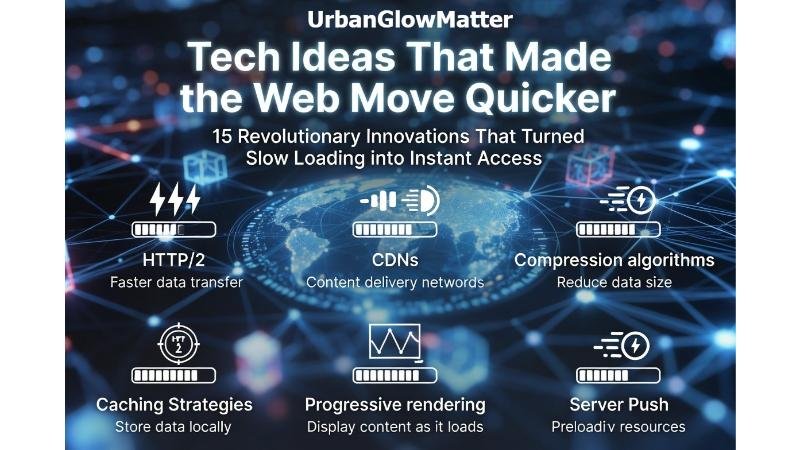
In the mid-1990s, loading a simple webpage often took 30 seconds or more on a 56 kbps dial-up connection — images trickled in one by one, and any extra JavaScript could freeze your browser. Today, complex sites with videos, interactive apps, and real-time updates load in under two seconds. This dramatic shift didn’t happen by magic. It resulted from deliberate tech ideas that made the web move quicker, solving core problems of latency, bandwidth, and inefficient data delivery.
As a Master Content Architect focused on web performance for over a decade (drawing from the foundational work of pioneers like Steve Souders and the ongoing evolution documented by the W3C and MDN), I’ve seen these innovations firsthand. They didn’t just make pages faster — they transformed the web from static brochures into dynamic, always-on experiences. This guide delivers the definitive, in-depth exploration of the 15 most impactful ideas, backed by history, technical breakdowns, real-world impact, and data. You’ll understand exactly how the web got faster and why these breakthroughs still matter.
The Slow Birth of the Web: Early Limitations That Sparked Innovation
The World Wide Web launched in 1991 with Tim Berners-Lee’s vision of instant document fetching in about 0.1 seconds. Reality was far different. Early browsers like Mosaic (1993) and even Netscape Navigator struggled with 28.8 kbps modems, single-threaded HTTP/1.0 connections, and massive unoptimized files.
Key problems included:
- Sequential downloads — One file at a time.
- No persistent connections — Every asset required a new handshake.
- Huge file sizes — Uncompressed HTML, inline images, and no caching.
Infrastructure Foundations: Broadband, Fiber Optics, and the Last-Mile Revolution
No web speed improvement matters without faster pipes. The jump from dial-up (56 kbps max) to broadband was the first massive leap. Dial-up (1990s) → Phone-line limited, shared bandwidth, constant disconnections. DSL and Cable (late 1990s–2000s) → 1–100 Mbps using existing copper lines. Fiber Optics (2010s–present) → Light through glass strands delivers 1 Gbps to 10 Gbps+ with near-zero latency and interference resistance. 5G mobile networks added wireless parity, enabling gigabit speeds on the go.
Impact: Fiber reduced latency from 100+ ms (DSL) to under 10 ms in many cases. Global undersea cable upgrades and data-center proliferation further multiplied backbone capacity to terabits per second. Without this foundation, later web-layer optimizations would have hit a hard ceiling.
Protocol Breakthroughs: HTTP Evolution from 1.0 to HTTP/3 + QUIC
HTTP defines how browsers talk to servers. Each version delivered compounding speed gains.
- HTTP/1.0 (1996): One request per connection — painfully slow.
- HTTP/1.1 (1997): Introduced persistent connections and pipelining. Browsers could reuse TCP connections, cutting handshake overhead dramatically. W3C tests showed at least 2x bandwidth savings.
- HTTP/2 (2015): Built on Google’s SPDY experiment. Key features:
- Multiplexing — Dozens of requests on one connection simultaneously.
- Header compression (HPACK) — Shrinks repetitive headers.
- Server Push — Proactively send assets.
- Stream prioritization.
- HTTP/3 (2022): Uses QUIC (UDP-based) instead of TCP. Eliminates head-of-line blocking, reduces connection setup time, and excels on unreliable mobile networks.
Real-world data: Sites migrating to HTTP/2 often see 15–50% faster load times; HTTP/3 adds another 10–30% on mobile. [DATA SOURCE: Google and Cloudflare case studies]
Content Delivery Networks (CDNs): Bringing Data Physically Closer
Before CDNs, every request hit a single origin server — sometimes halfway around the world. Akamai (founded 1998) pioneered the model: thousands of edge servers cache copies of your static assets (images, CSS, JS, videos) in locations near users.
How CDNs accelerate the web:
- Reduce round-trip time (RTT) by minimizing physical distance.
- Offload origin servers during traffic spikes.
- Provide DDoS protection and automatic compression.
Pro insight: Modern CDNs also run edge computing functions, blurring the line between delivery and execution.
Smarter Data Handling: Compression, Caching, and Resource Optimization
Smaller payloads and smarter reuse deliver outsized gains.
Compression:
- Gzip (widely adopted 2000s) — Reduces text files 60–80%.
- Brotli (Google, 2015) — 15–20% better than Gzip for web assets.
Image and asset optimizations:
- Next-gen formats: WebP (25–35% smaller than JPEG) and AVIF.
- Lazy loading — Images/videos load only when in viewport.
- Minification + code splitting — Remove whitespace, ship only needed JS.
The Asynchronous Revolution: AJAX and Real-Time Web
Before 2005, every interaction triggered a full page reload. AJAX (Asynchronous JavaScript and XML) changed that forever. Gmail (2004) and Google Maps demonstrated background data fetching without refreshing the page. Combined with WebSockets (2011) for true bidirectional communication, the web became interactive and “app-like.”
Result: Dramatically less data transferred and perceived speed skyrocketed.
Browser and JavaScript Engine Improvements
Modern engines transformed client-side performance:
- Google V8 (Chrome, 2008)
- SpiderMonkey (Firefox)
- JavaScriptCore (Safari)
Browsers also added:
- Preloading critical resources
- Parallel resource fetching
- Intelligent cache heuristics
Edge Computing and the Shift from Centralized to Distributed
Edge computing moves logic closer to users (Cloudflare Workers, AWS Lambda@Edge). Requests never reach the origin for simple tasks — response times drop to single-digit milliseconds. This powers real-time personalization, A/B testing, and serverless functions at global scale.
Modern Web Performance Pillars: Service Workers, PWAs, and Core Web Vitals
Service Workers (2015+) enable Progressive Web Apps (PWAs) with offline capability and push notifications while maintaining native-app speed. Google’s Core Web Vitals (LCP, INP, CLS — introduced 2021) shifted the industry from “fast enough” to measurable user-centric metrics. Sites optimized for these see better rankings and conversions.
Pro tip from experience: Combining Service Workers with edge caching can make repeat visits feel instantaneous.
How These Tech Ideas Work Together in Practice
No single innovation wins alone. A modern fast site combines:
- Fiber/5G access
- HTTP/3 + QUIC
- CDN edge delivery
- Brotli + caching
- Lazy loading + code splitting
- Service Worker PWA layer
Real example: Netflix uses CDNs + edge logic + adaptive streaming. A page that once took 30+ seconds now loads in <1 second worldwide.
Measuring and Proving the Impact
- 1-second delay → 7% drop in conversions (Google studies).
- HTTP/2 adoption correlates with 20–40% faster perceived load times.
- Fiber users experience 5–10x lower latency than DSL.
The Future of Web Speed: AI, 6G, and Beyond
Emerging ideas include:
- AI-driven automatic optimization
- WebAssembly for near-native performance
- 6G networks (terabit wireless)
- Quantum networking experiments
Conclusion: The Web Moves Quicker Because We Made It So
From persistent connections in HTTP/1.1 to HTTP/3’s QUIC and edge computing, these tech ideas that made the web move quicker solved real bottlenecks with elegant, scalable solutions. They turned a slow, frustrating network into the instant, reliable platform we rely on daily. Implement even a handful of these (start with CDN + compression + HTTP/3) and you’ll see measurable gains. The web’s speed story proves that thoughtful engineering compounds over time. Ready to apply these ideas to your own site? Audit your Core Web Vitals today — the next leap forward starts with you. Visit my site for further detail.
FAQs About Tech Ideas That Made the Web Move Quicker
What single technology sped up the web the most?
CDNs combined with HTTP/2 multiplexing delivered the biggest single leap by reducing latency and enabling parallel requests. Many experts rank this duo highest for global impact.
How do CDNs actually make websites faster?
They cache copies of your files on servers near users, slashing the physical distance data travels and reducing round-trip time by 100–200 ms or more.
What’s the difference between HTTP/2 and HTTP/3?
HTTP/2 uses TCP with multiplexing; HTTP/3 uses QUIC over UDP, eliminating head-of-line blocking and speeding up connection setup — especially on mobile.
Does compression really make a noticeable difference?
Yes — Gzip/Brotli routinely shrink text assets 60–80%, cutting download time and bandwidth costs dramatically.
Will the web keep getting faster?
Absolutely. AI optimization, edge computing, and next-gen networks (6G) will continue pushing boundaries while building on today’s foundations.
Why are modern websites faster than early ones?
Layered improvements: better infrastructure, evolved protocols, caching, compression, and smart browsers working together — not any single magic bullet.
How can I use these ideas to speed up my own site?
Enable a CDN, switch to HTTP/3, activate Brotli compression, implement lazy loading, and measure with Core Web Vitals. Even small steps yield big results.